Our Location
No.503 Xingguo Road, Yuhang Economic and
Technological Development Zone, Hangzhou

No.503 Xingguo Road, Yuhang Economic and
Technological Development Zone, Hangzhou

Learn how to choose an energy meter test bench by meter type, accuracy, test range, positions, communication, standards, and service support.
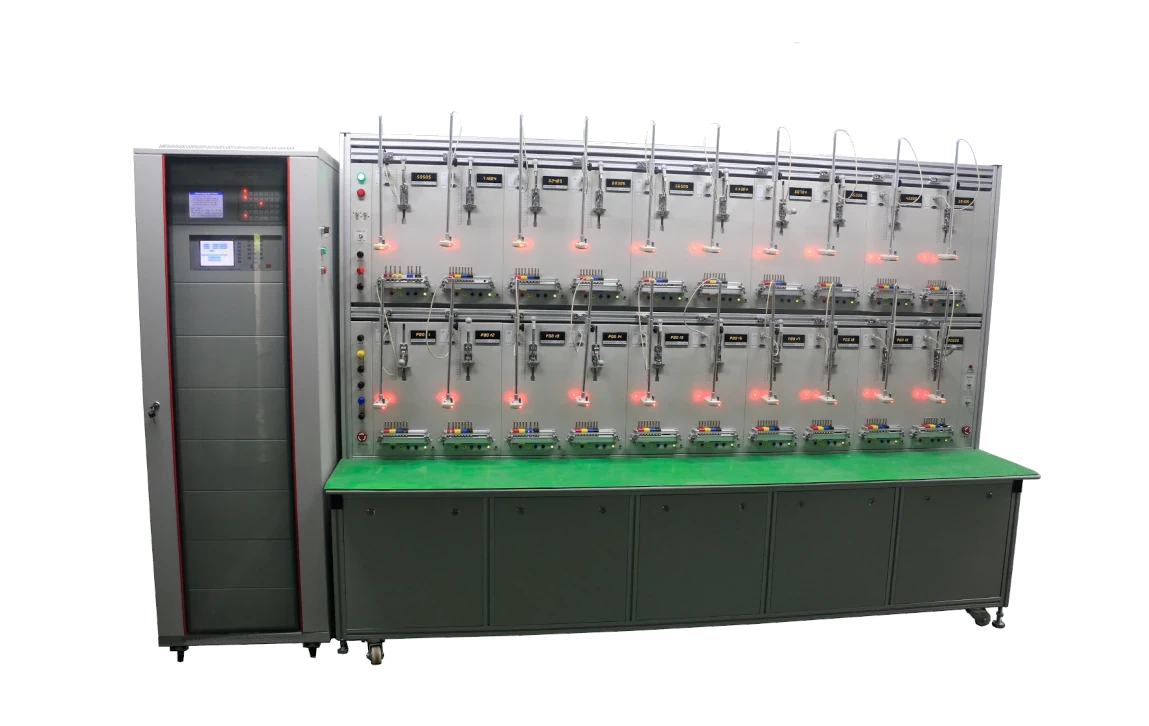
Choosing an energy meter test bench is a long-term technical and operational decision. The system must match the meters being tested today, support future products, provide traceable measurements, and remain practical to operate and maintain.
The first step is to define whether the bench will test single-phase meters, three-phase meters, direct-connected meters, transformer-operated meters, smart meters, or a mixture of designs. Meter dimensions, terminal arrangement, communication protocol, and pulse output also affect the fixture and software requirements.
A single-phase meter test equipment system and a three-phase smart energy meter test bench may look similar, but their electrical configuration, source requirements, and control software are different.
Do not select a test bench only by its advertised reference accuracy. Review source stability, temperature drift, resolution, repeatability, pulse measurement uncertainty, and the uncertainty contribution of the complete measurement chain.
The reference system should be sufficiently more accurate than the meters being tested. For example, a laboratory testing class 0.2 or 0.5 meters requires a different uncertainty budget from a production line testing meters with tighter limits.
Define the minimum and maximum voltage, current, frequency, and power factor. Consider starting current, minimum current, maximum current, phase angle, harmonic influence, and future meter designs. A system that only covers today’s products may become restrictive when the product portfolio changes.
Positions determine throughput, power demand, floor space, and operator workload. A laboratory may only require a small number of positions, while a factory line may need 24, 48, or more. Calculate throughput using test time, loading time, unloading time, retests, and planned maintenance.
Smart meters may use DLMS/COSEM, Modbus, M-Bus, or proprietary protocols. The test software should be able to read and write meter data, control the source, record events, generate reports, and connect with production systems when required.
For high-volume production, automation may include barcode identification, automatic positioning, power-on testing, error calculation, sorting, and data upload. An automatic energy meter calibration line can combine these functions into a continuous process.
Confirm which standards the test plan must cover and whether the supplier can support test procedures based on IEC 62052, IEC 62053, IEC 62057, and related communication specifications. Ask how reference meters, sources, and pulse circuits are calibrated and how traceability documents are provided.
Review spare parts availability, software updates, training, remote support, calibration intervals, and typical downtime. A technically strong system with slow service support can create significant operational risk.
Choose a stationary bench for laboratory or production testing where throughput and repeatability are important. Choose portable equipment when meters must be tested or calibrated on site.
Yes, if the electrical range, fixtures, communication interfaces, and software are configurable. Complex mixed-model production may require separate stations or changeover kits.
Provide meter types, accuracy classes, communication protocols, test standards, annual volume, required test points, voltage and current ranges, available space, and any automation or reporting requirements.
To define a suitable configuration, review our energy meter testing equipment or contact our engineering team.
Before placing an order, ask the supplier to explain the measurement chain, calibration method, spare-part strategy, software ownership, and expected service response. Request examples of similar systems and a clear acceptance-test procedure.
Evaluate the total cost of ownership rather than purchase price alone. A stable system that produces reliable data can reduce retests, customer disputes, and unplanned downtime.
A high accuracy class does not compensate for poor source stability, weak contact design, or inadequate measurement uncertainty. Review the complete system.
Meter designs, communication protocols, and current ranges change. Select equipment with sufficient range and software flexibility to support future products.
Power consumption, floor space, calibration, fixtures, software maintenance, training, and service response all contribute to the total cost of ownership.
