Our Location
No.503 Xingguo Road, Yuhang Economic and
Technological Development Zone, Hangzhou

No.503 Xingguo Road, Yuhang Economic and
Technological Development Zone, Hangzhou

Energy Meter Testing Equipment, including test benches, are crucial for assessing, calibrating, and verifying the accuracy and functionality of energy meters against standards like IEC62057, IEC62053, and DLMS/COSEM. This ensures compliance with industry and regulatory benchmarks for measurement accuracy under diverse load conditions.
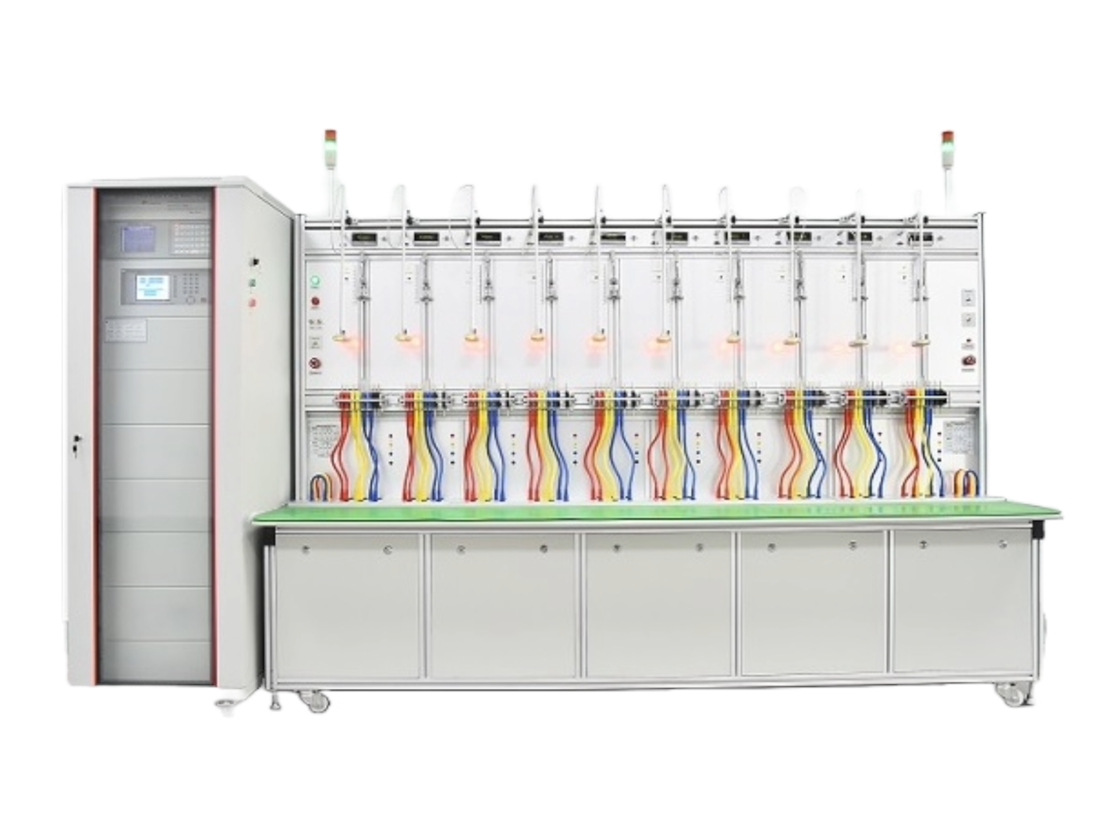
Energy meter testing equipment is used to verify the accuracy, repeatability, functionality, and compliance of electricity meters before they enter service or after repair. A properly selected system helps manufacturers, utilities, and calibration laboratories reduce measurement uncertainty and maintain consistent test results.
An energy meter test bench combines a stable power source, reference measurement system, meter positions, control software, and data collection functions in one integrated platform. It applies controlled voltage and current to multiple meters and compares each meter’s output with a traceable reference standard.
Modern systems can test single-phase meters, three-phase meters, direct-connected meters, transformer-operated meters, and smart meters with communication interfaces. The best configuration depends on meter type, accuracy class, production volume, required test standards, and available laboratory space.
Stationary test benches are designed for factories, national metrology institutes, and calibration laboratories that require high throughput and repeatable conditions. Multi-position designs can test many meters simultaneously, while automated handling systems support continuous production testing.
Typical applications include type testing, routine verification, error testing, influence-quantity testing, and final quality inspection. For high-volume production, an automatic energy meter calibration line can integrate loading, positioning, testing, sorting, and data collection.
Portable calibrators are used when meters cannot be removed from service or when utilities need to verify installations in the field. A three-phase onsite calibrator can measure voltage, current, power, energy, phase angle, and power quality while comparing the installed meter with a reference standard.
A stable reference standard is the core of every accurate test system. It provides traceable measurements for voltage, current, power, and energy. Depending on the application, users may select a three-phase reference standard meter, a portable onsite standard, or a high-accuracy laboratory reference.
The test process begins by defining the test point, voltage, current, power factor, frequency, and test duration. The source applies the selected conditions to all meter positions while the reference system measures the applied energy. The software then calculates each meter’s percentage error and records the result.
Accuracy class alone is not enough. Long-term stability, temperature drift, source distortion, resolution, and repeatability also influence measurement uncertainty. Buyers should compare the complete measurement chain rather than only the displayed accuracy specification.
The number of positions determines throughput and floor-space requirements. A small laboratory may only need 3 to 10 positions, while a production line may require 24, 48, or more positions. The correct choice depends on annual volume, test time, and changeover frequency.
The system must cover the full operating range of the meters being tested. Consider direct and transformer-operated inputs, low-current starting tests, maximum-current tests, power-factor conditions, harmonic influence, and future product requirements.
Smart meters often require DLMS/COSEM, Modbus, M-Bus, or other communication protocols. Automated test software should be able to read meter data, control the source, record errors, generate reports, and exchange data with a manufacturing execution system.
Energy meter test equipment may need to support IEC 62057 requirements for test equipment, IEC 62052 and IEC 62053 requirements for electricity metering equipment, and DLMS/COSEM communication testing. The exact scope depends on the meter type and target market.
For an overview of how test equipment supports compliance programs, see smart energy meter test bench compliance and accuracy testing.
A test bench should be calibrated at planned intervals using traceable reference equipment. Maintenance includes checking source stability, cleaning connections, verifying pulse inputs, updating software, and confirming safety interlocks. Calibration records should include the reference standard used, environmental conditions, test points, uncertainty, and acceptance criteria.
Multiply the expected daily meter volume by the required test time, then include time for loading, unloading, retests, and maintenance. A higher number of positions can improve throughput but also increases power, space, and maintenance requirements.
Some systems support both, but the electrical configuration and meter fixture must match the meter design. Separate test benches are often preferred when production volume or technical requirements are high.
A reference meter measures voltage, current, power, and energy with high accuracy. A test bench integrates reference measurement together with sources, meter positions, control software, and automated testing functions.
To discuss the correct configuration for your laboratory or production line, contact our engineering team or review our energy meter testing equipment.
Enter your email address below and subscribe to our newsletter

[…] Energy Meter Testing Equipment: Types & Applications […]