Our Location
No.503 Xingguo Road, Yuhang Economic and
Technological Development Zone, Hangzhou

No.503 Xingguo Road, Yuhang Economic and
Technological Development Zone, Hangzhou

The post describes a Smart Meter Test Bench designed to comply with international standards IEC62057 and IEC62053, which cover test equipment, techniques, and procedures for electrical energy meters. It also adheres to the DLMS/COSEM specifications for energy metering.
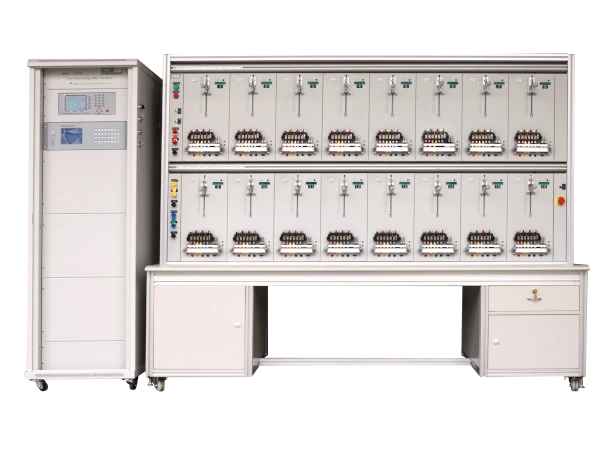
A smart energy meter test bench is used to verify measurement accuracy, operational behavior, communication functions, and compliance with applicable standards. For manufacturers and utilities, the test bench is not simply a calibration tool. It is part of the quality system that determines whether meters can be released, accepted, or returned for correction.
Electricity meters are revenue and control devices. Small measurement errors can become significant when multiplied across large volumes of energy, while communication or functional failures can affect billing, load control, and grid operations. A structured test program helps identify these risks before meters are installed.
Compliance testing confirms that the meter meets the relevant product standard and declared accuracy class. Accuracy testing verifies that measurement error remains within the specified limits across voltage, current, power factor, frequency, and temperature conditions.
The test bench generates controlled voltage and current while a reference standard measures the applied power and energy. Each meter position receives the same test conditions, and the system compares the meter’s pulse output or communication data with the reference measurement.
Accuracy class describes the maximum permitted error for a meter under specified conditions. Test equipment must be significantly more accurate and stable than the meter being tested so that the measurement uncertainty does not dominate the result.
Typical production systems may use accuracy classes such as 0.02 or 0.05, while higher-performance laboratories may use 0.01-class reference equipment. The required accuracy depends on the meter class, test method, uncertainty budget, and regulatory requirements.
Basic error testing compares meter energy registration with a reference standard at defined voltage, current, and power-factor points. Tests may cover starting current, minimum current, transitional current, maximum current, unity power factor, and phase-shifted conditions.
Repeated measurements at the same test point show whether the meter and test system produce consistent results. Poor repeatability can indicate source instability, poor contact, temperature drift, meter firmware behavior, or an inadequate test procedure.
Voltage variation, frequency deviation, harmonic distortion, temperature, magnetic fields, and power-factor changes can influence meter accuracy. Test benches with programmable sources and environmental monitoring make these evaluations more repeatable.
Smart meters may use DLMS/COSEM or other communication interfaces. Test software can verify registration, tariff switching, event logs, load profiles, demand values, firmware data, and communication reliability.
Meters may be tested for reverse current, missing voltage, phase failure, magnetic influence, cover opening, and other events. These tests help confirm that the meter records and reports abnormal conditions correctly.
IEC 62052 and IEC 62053 define general and particular requirements for electricity metering equipment, including accuracy and type-test conditions. IEC 62057 addresses test equipment, techniques, and procedures used to evaluate electrical energy meters.
In practice, the standards define the requirements and test methods, while the test bench provides the controlled source, reference measurement, positions, communication, and software needed to execute them. The exact test plan depends on meter type and market.
For high-volume production, an automatic meter calibration and verification line can connect these elements into a continuous process. For laboratory and mixed-model testing, a flexible three-phase smart energy meter test bench is often more suitable.
Start with the meter types, accuracy classes, communication protocols, production volume, and standards that must be covered. Then define voltage and current ranges, number of positions, source stability, reference accuracy, software requirements, reporting, integration, and floor-space limitations.
Also review calibration support, spare parts, software updates, training, safety design, and service response. A technically capable system that is difficult to maintain can create more long-term cost than an initially lower-priced alternative.
Test results are only meaningful when the system is traceable to recognized standards. Reference meters, voltage and current sources, pulse measurement circuits, and environmental sensors should be calibrated on a planned schedule. Calibration certificates should state measurement uncertainty and the conditions under which the results apply.
Accuracy testing determines whether a meter meets specified error limits. Calibration establishes the relationship between the meter indication and the reference value and may include adjustment or correction.
Yes, when the system includes the required communication interface and software. The bench can verify reading, programming, events, tariff data, load profiles, and protocol behavior.
The interval depends on the manufacturer’s recommendations, usage, stability history, regulatory requirements, and internal quality procedures. Critical reference equipment is often calibrated annually or more frequently.
For application-specific recommendations, contact us or review our energy meter test bench solutions.
Enter your email address below and subscribe to our newsletter

[…] see our three-phase smart energy meter test bench, three-phase reference standard meter, and smart meter compliance and accuracy testing guide. You can also contact our engineering team for application […]
[…] Smart Energy Meter Test Bench: Compliance & Accuracy Testing […]
[…] Smart Energy Meter Test Bench: Compliance & Accuracy Testing […]